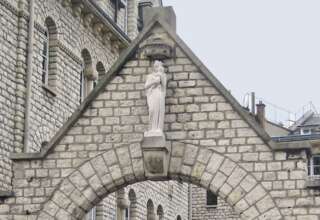

I begin to weave the fictious tale regarding Jim, the most recent owner of the now-closed restaurant:
“Jim decided one day to journey with his wife to Monhegan Island, a legendary artists colony off the coast of Maine [this island and its artistry does exist]. Jim spent several days on the island, observing many artists with their palettes and easels placed near the edge of the sea painting crashing waves, sea gulls, lobster boats and colorful sunrises and sunsets. Jim returned home and had a dream the first night back home.
Jim dreamed of being an artist himself, who set up his easel near the Monhegan cliffs. He was painting with great passion and was soon joined by his wife, several of his friends and then members of his own childhood family. They were also painting and talking with one another about art and life lessons. Jim was totally enthralled with the creative work being done and the richly textured conversations taking place.
Suddenly, the scene shifted to the building he had recently purchased. To his surprise, his wife, friends and family members were still painting. Their easels were now located in his vacant building. They were now painting from memory of their time on the Monhegan seashore. Jim found that his own easel and palette were awaiting him. He began to paint a picture of a Monhegan oceanside crevice where the sea was swirling about. Jim then woke up.
Almost immediately, Jim began to imagine turning his restaurant into a set of studios where local artists could work and sell their wares. Many artists reside in my Maine village. Most of them work out of their homes. Jim could bring them together so that they might interact with one another (as in the dream) and so that they could readily sell their finished work in a highly visible collective setting. And there would not be the problem of limited water (no meals to serve!) and the parking would not be a problem since there would only be the artists and occasional visitors.”
This is where the fiction ends and reality returns. The actual restaurant was recently turned into a set of studios for artists, an art gallery, and a public space for the offering of workshops and art-related educational events. While I imagined the dream, this whole narrative emerged for me in one of my own dreams and in a set of hypnogogic (waking) images I had that I was able to assemble into this fictitious narrative.
I wish to highlight several aspects of this narrative that are not fictitious. First, the transformative process is common in dreams. The critical shift of settings from Monhegan to Jim’s building exemplifies a frequent dynamic taking place in dreams. I would suggest that these transformations often signal the emergence of an important insight or moment of guidance. Using Barrett’s metaphor, the committee is convened and is about to “get down to business.”
Second, I suggest that the selection of people to serve on the committee is important. Jim chose to bring his wife, friends and childhood family members to Monhegan and then to his building. His committee was composed of people he trusted. This trust might be critical to Jim’s decision to take on the challenge of “thinking [and envisioning] outside the box” when considering setting up a collective art studio rather than a restaurant.
Third, Jim saw himself doing some of the creative work. While he would not have a place himself at the studio he envisioned, Jim could conceive of himself as being highly creative in re-inventing the restaurant as a collective studio, and in envisioning not just a gallery where paintings were sold, but also a series of workshops and educational events that would benefit his Maine community in additional ways.
The studios of the newly re-envisioned building are already filled, the art gallery opened last week to great acclaim, and the first set of workshops are planned for this Fall (after the tourists leave). Whether or not there was a Monhegan-based dream, a dream-like envisioning of this buildings’ owner has produced something that is the creative rendition of a creative “play space”. It seems that dreams are often “play spaces” (Winnicott, 1971) for dreamers who are faced with difficult decisions regarding such matters as use of a vacant building standing on a rocky Maine seashore.