

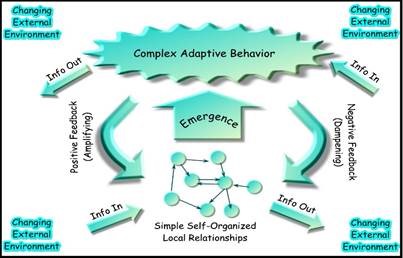
Diagram: The Wiki and the Blog: Toward a Complex Adaptive Intelligence Community D. Calvin Andrus, Ph.D. Office of Application Services Central Intelligence Agency Washington, DC 20505 calvina@ucia.gov
Intersections: I offer a third way in which to describe this relationship between creativity and nothingness. Franz Johansson (2004) writes about the Medici Effect (referring back to the leadership provided by the Medici family during the Italian Renaissance). This effect is present when often-competing disciplines intersect. New solutions are generated in this intersection. Members of one discipline are curious about what those in another discipline have to say.
New learning can occur when alternative perspectives on an important issue are introduced. Artists can learn from scientists. Historians can provide insights for those who are engaged in politics. I have conducted sessions where art professors at a college learn about laboratory-based teaching from chemistry professors, while at the same time teaching these chemists about the use of studios as a mode of education.
Members of an organization can hold opposing and contradictory views and still be effectively and creatively engaged with one another—provided that curiosity is complemented by a motivation to learn. By being curious about the other side’s perspective, they can make more thoughtful and accurate predictions and take more appropriate actions in a VUCA-Plus saturated environment (Bergquist, 2026).
Actually, entire organizations reside at the intersect. Kenneth Boulding (1973) prophetically described the Intersect Organization more than fifty years ago. At the time, these new kinds of organizations held great promise in solving longstanding problems in our society. Yet these intersect organizations have also been subject to troubling ambiguity given their venture into the nothingness of societal gaps. According to Boulding (1973, p. 179):
“. . . .many societies have witnessed the development of “peculiar” organizations which did not fall into any of the well-recognized categories. They are not quite government, although they are usually the result of some kind of government action. They are not quite business, although they perform many business functions. They are not quite educational or charitable organizations either, though they may also perform some of these functions. They frequently occupy “cracks” or interstices in the structure of a society. They have been named “intersects” because they have some qualities of more than one conventional type of organization.”